
Planet Mars Conquers the Russians
Russia's Mars 96 was one of the most advanced spacecraft of the 20th Century. Designed to be the first vessel to explore the Red Planet, its mission was to drill up to 20 feet below the surface in search for life. But beyond the (literally) groundbreaking science, Mars 96 had another purpose: Rescue the country's dying space program and prove to the West that the post-Soviet Russia was worth investing in. With the last of the struggling nation's resources pooled into this one mission, there's only one chance to make this work. Will it succeed?
If this is your first time hearing about Mars 96, you might be able to guess the answer. Join us for this week's episode to find out how it all went wrong and what this mission's failure meant for the future of Russian's space program.
Sources:
https://spp.fas.org/eprint/mars96lo.htm
https://space.skyrocket.de/doc_sdat/mars-96.htm
https://www.russianspaceweb.com/spacecraft_manned_mars.html
https://www.nasa.gov/wp-content/uploads/2023/04/sp-4515.pdf
http://www.astronautix.com/r/russianmarsexpeditions.html
https://www.planetary.org/articles/3361
Newspapers:
Shine Fades from Russian’s Once-Exalted Space Program (San Francisco Chronicle 3/22/97)
NASA’s new Mars missions are the beginning of a decade-long focus on the red planet (The Toronto Star 12/01/1996)
‘Galactic ghoul’ strikes again (The Blade 3/14/1997)
Russia’s space jinx (The Age 12/23/1996)
Episode Transcript
Cory: On November 9th, 1996, a large crowd gathers at the Baikonur Cosmodrome in Kazakhstan. This facility, the largest spacecraft launch site in the world, saw some of the Space Race's most famous missions, including Sputnik, the first man-made object to orbit Earth, and Vostok 1, which carried the first human into space.
Today, another historic mission is moments away from launch. This is Mars 96, and it's going to be the first spacecraft to search for life on Mars. Just before midnight, ground control begins the launch countdown. The crowd hushes. Three, two, one. And the earth trembles under the power of a proton rocket. The massive launch vehicle slowly lifts, and spectators crane their necks in awe as the rocket thunders into the clear autumn sky. It's a perfect launch. project leaders and state officials head to the banquet hall to celebrate with cognac and vodka.
Minutes later, the rocket enters its first orbit, and mission control prepares for the final burn that will allow the spacecraft to escape Earth orbit and begin its final trajectory into history.
unfortunately, that's not how this mission ends. Despite the fact that Mars 96 was one of the most ambitious interplanetary programs of the 20th century, there's a reason you probably haven't heard of it. And its loss had consequences that went well beyond setting back our understanding of the red planet. Ultimately, the failure of Mars 96 crippled the Russian space program, a reality that continues to this day.
Today on "Lost Threads," Mars 96 and how this mission's failure changed space forever. I'm Cory Munson.
Cameron: And I'm Cameron Ezell. We'll be right back.
Mars 96 was a mission with two objectives. The first was to go to Mars and look for life.
But this mission had another goal. One that was an incredibly risky gamble. Mars 96 was Russia's one chance to prove to the world, and itself, that it was still a major player in space.
At the time of launch, Russia was a shadow of its former self, still reeling from the collapse of the Soviet Union. To Russians, Mars 96 was a literal symbol of hope in overcoming their grim post-Cold War reality. Despite nationwide blackouts, crippling strikes, record crime, and political upheaval, the cash-strapped nation pooled its very limited resources into developing one of the most advanced spacecrafts of the 20th century.
If there was ever a case of a country entrusting its future into a single project, this was it. So let's talk about how we got to this point. Why this mission? What were the stakes and how did it all fall apart?
Cory: Before we dive into Mars 96 or the Russian Mars program, let's roll back the clock to see how Russia found itself in this position. There are plenty of dates we could start this story at, but I'm gonna pick December 26th, 1991.
Cameron: This might actually be our first episode where we're both alive during the context section.
Cory: This is true, but I was two years old. I was barely alive. December 26th, 1991, that's when the Soviet Union officially dissolved. At midnight, president Mikhail Gorbachev resigned, and a world superpower suddenly blinked out of existence.
You could spend a lifetime talking about the final years of the Soviet Union. I have no desire to do that for this episode. But what's important for our story is the quality of the institutions and the economy of the country that inherits what's left of the old empire. That country, of course, is the Russian Federation.
In short, things are really bad.
Cameron: Yeah. Like super bad. It was functionally a failed state, which was made worse because the state used to provide all the basic services like education and healthcare.
Cory: And like you said , there were nationwide protests, food shortages, an epidemic of substance abuse. There were cities run by crime families, many of which became the oligarchs that still run the country today.
And there was a lot of unemployment. A big part of that was because now that Western goods had flooded the country, the older Soviet products had no hope of competing. So lots of factories closed.
Cameron: For older folks, this must have just been head spinning because a few years earlier they lived in, you know, not necessarily a utopia, but they were a military and cultural world power. There were Russians working in space, and then suddenly the Moscow Metro is basically a refugee camp.
One story that shows how sudden the collapse was is about Sergei Krikalev, who was stationed on the space station Mir when the Soviet Union fell. When he came home in 1992, he was still wearing his Soviet uniform, representing a country that didn't exist.
Cory: Man, that's a Twilight Zone episode.
So things are terrible. Russia is on life support. But all is not lost. There are still two cornerstone programs inherited from the USSR that have survived relatively intact and they're kinda Russia's last two chips to be a global contender. Those are the nuclear weapon program and, of course, the space program. For civilians and politicians alike keeping both of these are non-negotiable.
Cameron: You can see why the space program had to stick around. I imagine they were all pretty proud of all the space race victories, and they just ran circles around the US during the Cold War.
Cory: Right. This is the country that invented the intercontinental ballistic missile and then used it to launch the first satellite and then dominated the space race pretty much until the 1970s.
Cameron: They had the first dog in orbit, the first spacecraft to touch the moon.
Cory: First dog to return from orbit alive.
Cameron: They had the first human in orbit, first crew in orbit, first Space Walk, first Space station.
Cory: Yeah, they were good at space. And cutting the program would probably be like asking Americans to sell off Hollywood. Their space program was as much a cultural institution as it was a scientific one.
But it wasn't all about national pride. The space industry was a profitable job creating sector. Like even in the 1990s, Russia was selling their proton rockets to pretty much everybody, even the US.
Cameron: During this time, the US had gone all in on their shuttle program, and Russia, even in the condition it's in, was still the only nation producing reliable rockets in the eighties and nineties.
Cory: Now, selling those rockets was not going to sustain the Russian space presence. And in fact, even though desperately needed funds were going towards the space industry, it was still struggling to maintain the few programs it had going on. The government was basically broke.
Cameron: And this shouldn't come as a surprise, but everything in Russia was underfunded, not just the space program. Only a month before Mars 96 launched, the country's head nuclear scientist, Vladimir Nechai shot himself to protest how the country had stopped investing in science and education.
Cory: And to add salt to the wound, Russia didn't even own its most important space infrastructure. After the Soviet Union dissolved, a lot of the periphery places became sovereign nations, and now they had all the cool Soviet stuff. Yevpatoria, Ukraine had the mission control center. Kazakhstan had that launch facility we mentioned in the intro. Russia still used those, but now they had to pay millions of dollars just to lease them.
So the biggest issue with this limited funding is that the Space agency, which is called Roscosmos, can't pay their workers. And it's not even that they're not earning a competitive wage, they're just not getting paid. At the time of Mars 96's launch, many hadn't seen a paycheck for five months, and the ones that were getting paid were making what is today, like $260 a month.
And the consequence of that is Roscosmos started to hemorrhage talent.
Cameron: Even into the nineties, the Russian space program was still cutting edge and competitive with the USA. But at this time, a young person with an aerospace or engineering degree had very little incentive to stick around, especially when other countries with an emerging space industry are recruiting. During this time, the average age at Roscosmos was 50.
Cory: But there's another problem with underfunding the space program, and that brings us to the heart of this story.
The fact is, with the money they have, there just aren't that many projects they can work on at a single time. They've got the Proton Rockets and they've got the Mir Space station. Both of those were inherited from the Soviet Union, but both programs were also in really rough shape. In 1996, Mir was in the news because it was falling apart in orbit and there wasn't enough cash to get a rocket up there to fix it.
Cameron: The astronauts that were up there, two Russians and an American, they had to stir the septic tank every day for months until Roscosmos could send a ship up.
They had to knock the volume down 'cause there was all this air building up in between the poop.
Cory: Anyway, much of the budget goes towards keeping these inherited Soviet programs in a state of basically a slow decay. But if Roscosmos wants to survive and grow and continue being a space leader, they need money. Obviously that is not going to come through the Russian government. If they want funding, it absolutely needs to come through international investment.
And the only way they'll get that investment is by proving that Russia is worth investing in. There is only enough domestic funding for one big project.
Whatever they choose, it can't be a half measure. This has to be something special. They've got to blow the socks off investors, i.e., the west, and show off everything Russia is capable of. But if it fails, everyone knows that there will no longer be enough money or political will among the Russian people to continue funding the space program in any meaningful way.
And that's how we get to the Hail Mary pass that is Mars 96.
Cameron: Russia is taking a huge gamble with the Mars 96 mission. The stakes are high, and if the mission fails, Roscosmos knows the space program will likely never recover, but it's not just the funding and risk that made them nervous about a mission to Mars.
The fact is, Russia had an awful track record when it came to the Red Planet. Of the 17 missions the Soviet Union sent since 1960, almost every one of them ended in total failure.
Which begs the question, if you're going to put all your space eggs in one basket, why pick a planet that has for the past 36 years remained unconquered?
Whether it was bad luck, poor planning, faulty engineering, or a combination of all those factors, Russia has never had a fully successful mission to Mars. And as Roscosmos began planning Mars 96, they likely couldn't help but look back at the past missions and ask what lessons they could learn from those failures.
So Cory, walk us through an abridged history of Russia's horrible track record of missions to Mars.
Cory: The first mission to Mars in history was launched by the Soviet Union in October, 1960. That was a tiny little probe called 1M and its job was to do a flyby of the planet and take pictures.
Cameron: And this is 1960, just three years after Sputnik, which is crazy 'cause Sputnik was basically a tin can with a little radio transmitter and now they're doing a fly by of another planet.
Cory: Well, let's see if they can get off this planet first. After takeoff, 1M's pitch control stopped working and it burnt up in the atmosphere.
But, as we'll see is often the case for these missions, there's a backup craft ready to go. So four days later, we get the second mission to Mars in human history.
1M number two. This one got a little farther, but it's stage three rocket didn't light and it fell back to earth to also burn up in the atmosphere.
Cameron: Well, these are baby steps.
Cory: The next mission to Mars happened two years later in 1962. These were three launches over the course of two weeks. The first one was Sputnik 22. Sputnik 22's engine exploded in the atmosphere due to a lubricant leak.
Interestingly, this was during the Cuban Missile Crisis and it's launch scared the hell out of Americans for a brief period.
Cameron: By the way, just outta curiosity, how big are these vessels? Like, not the rockets but the spacecraft itself.
Cory: So far, these are like 1500 to 2000 pounds. So as much, I don't know, as like an old VW Beetle. They look like giant Daleks. We'll have them on the website if you wanna check 'em out.
Okay, so the first 1962 launch was a bust, but the second one, which happened a few days later, was way more successful. This was Mars 1. I don't know why this gets Mars 1 when it's the fourth mission so far, but there you go.
This was the first Russian Mars mission to successfully complete its launch and then start heading towards the planet .
Cameron: And this would've been the first ever interplanetary probe in human history, but NASA's Mariner two, which was headed to Venus, beat them by just three months.
Cory: Also, unfortunately, Mars 1 stopped working about four months into its journey. Something probably went wrong with its antenna.
The final launch of 1962 was Sputnik 26. Now, this one was designed to land on the surface of Mars.
Cameron: and this seems kind of ambitious 'cause they haven't even completed a reconnaissance mission yet.
Cory: Agreed, but it won't get anywhere near the planet because during launch its engine fuse shook loose, which meant that its fourth stage rocket couldn't fire.
If it had worked, it would've been the first probe to land on another planet.
The next mission to Mars was in 1964. That was Zond 2!
Cameron: Which sounds like a cheap sci-fi film.
Cory: Right, with rotoscoping. Zond 2 has the same problem as Mars One. It launches, but lost communication halfway to the planet. Now, the next Russian mission would have to wait five years until 1969. This was 2M 521.
It didn't even make it into orbit. A few days later was 2M 522, which caught on fire immediately after launch.
Cameron: These two were five years after the last launch attempt. I feel really bad for these scientists.
Cory: I promise you, brighter days are ahead. The next launches were two years later in 1971. That was an important year because the Mars Earth orbits were at one of their closest points, which means a much shorter travel time. So the Americans launched two crafts, which we'll get to in just a second. And the Russians launched three. Kosmos, 419 was the first. It has a successful launch and makes it into low earth orbit. But someone incorrectly set the timer for its final rocket stage. They programmed it to go off 1.5 years later rather than 1.5 hours later. The spacecraft fell back into the atmosphere two days later.
But then, hold onto your helmets! Because we get our first two partially successful missions. Mars 2 and Mars 3 - both launched in May, 1971. Their mission was to go to Martian orbit and send down a probe to the surface that was basically a weather station. Then the spacecraft would stay in orbit and collect atmospheric data. Let's talk about Mars 2 first. It has a successful launch. It leaves earth orbit. It survives the journey to Mars. It arrives in Martian orbit. We finally survived the journey.
Cameron: there was a potential space race record here, which was to be the first craft to enter a stable orbit around another planet .
Cory: But unfortunately, the Americans arrived first. One of those two crafts we mentioned earlier, Mariner 9, entered orbit just 15 days earlier.
Cameron: Oddly enough, Mars 2 launched 11 days before Mariner 9.
Cory: Yeah, I'm not sure how that worked out. Maybe the Americans had a favorable wind. Now, I said Mars 2 was a partial success. It did enter orbit, but remember its primary mission was to set a lander on the surface, which by the way, carried a tiny little primitive rover.
The spacecraft did collect some data from orbit, which is why this mission gets some credit. Mars 3, the redundancy for Mars 2, was even more successful. It arrived a few weeks later and its probe made a successful landing, making it the first working probe on Mars. However, that probe stopped transmitting 14 seconds after landing on the surface, which is probably because it was parachuting through a dust storm and had a lot of static electricity knock out its internals.
Cameron: The Soviets received 79 scan lines of imagery from the surface of Mars during that small window, but it looked like a bunch of nonsense to them, so they just didn't share it. Years later, scientists looked at the supposedly worthless images and were pretty shocked because they had the first image of the Martian horizon.
Cory: And at this point, I think it's worth saying that I know we're building a narrative that Mars 96 was haunted by its failed predecessors, but let's take the time to state the obvious. That space is really hard and there's a lot to learn. Like with these Mars 2 and 3 missions, they're doing things that were impossible for them 10 years earlier, and many of the things that they were attempting, like landing a rover on the surface, wouldn't be successfully achieved for decades.
Cameron: Right. For example, the first rover on Mars wouldn't be until 1997, but we also have to score them on what their goals were. If they'd reframed the mission as get an orbiter to Mars and send back some atmospheric data for six months, which Mars 2 and Mars 3 did, then they would've been successful missions.
But their goal was to send a probe down and it failed, and that's probably how the engineers and scientists felt about it.
Cory: Also, nobody's talking about the weather data sent back from Mars 2. What they're talking about instead is the data and mapping sent back from Mariner 9, which had way more impressive imaging because that was the whole purpose of its mission.
Okay. Believe it or not, we only have a few more to go. It's now summer 1973 and the Soviet Union launches four missions. Mars 4 and 5, which were orbiters, and Mars 6 and 7, which were going to land probes. All had successful launches and journeys to Mars, but it was a different story when they finally got to the planet. Let's go a numerical order. Mars 4's, retro rockets failed to work, so it couldn't slow down as it approached the planet. It snapped a few photos as it flew by into oblivion.
It's kind of crazy to think like it's still doing that, you know, like it's
Cameron: Still out there somewhere,
Cory: Just a hunk of metal that missed its target 50 years ago.
Mars 5 entered orbit, but stopped sending data back after a few days, which is probably because it was damaged by a micro meteoroid.
Mars 6's lander crashed onto the surface. And what little data it did send back was all junk because apparently its microchips had degraded.
Speaking of bad microchips, this was also a problem for Mars 7. Its lander was incorrectly aligned with the planet and it totally missed the atmosphere by about 800 miles.
Cameron: All four missions were a flop. That had to be so demoralizing.
Cory: Absolutely, and if you want proof of that, the USSR wouldn't attempt another Mars mission for 15 years. The final two missions to Mars for the Soviet Union were Phobos 1 and Phobos 2. They both launched in July, 1988. If the names weren't a giveaway, these were designed to study the Martian moon of Phobos.
For Phobos 1, trouble came just two months into its journey. In September, ground control didn't receive a transmission it was expecting to get from the craft. This was ultimately traced to a bad key command sent by a technician.
Cameron: Right. Normally these commands were supposed to be proofread by a computer before transmission, but the computer that checked the code was malfunctioning, so rather than waiting for it to be fixed, a technician sent the command anyway and violated the procedure. That faulty code deactivated the attitude thrusters, which made Phobos 1 lose its lock on the sun.
And since it couldn't orient its solar arrays, its batteries just depleted.
Cory: And Phobos 2 didn't fare much better. By the time it reached Mars orbit, two of the three computers were malfunctioning.
The probe depended on at least two computers to agree on a decision. But because two weren't operating correctly, the one healthy computer could never outvote them.
Phobos 2 still managed to take a few dozen photos and observed about 80% of the moon's surface.
Cameron: So it's a partial win.
Cory: That's it. Phobos 1 and 2 were the final Soviet missions to Mars.
The country collapsed three years later.
Cameron: Now that we have a little more background, we can return to Mars 96. Not only would it be designed in a desperate, poorly funded environment, not only was it a long shot plan to demonstrate Russian space prowess, it also stood on the shoulders of nearly four decades of missed opportunities and disappointment.
Roscosmos had everything to lose and so much to gain with a high profile, cutting edge mission to Mars.
But first they had to build it.
Cory: Before there was Mars '96, there was Mars 94. And before there was Mars '94, there was Mars ' ninety two
Let's go back to 1987, the year before the failed Phobos 1 and 2 missions. That year, Soviet Space Command mapped out a decade of increasingly daring Mars projects, the first of which was scheduled for 1992.
Mars 92 was going to do something that no one had done before: land a rover on the planet. Two rovers, in fact.
For context, those rovers were designed to be five hundred and thirty pounds each. The actual first rover on Mars, America's Sojourner, was twenty-five pounds. Also, Mars 92 was to have soil penetrators, which we'll describe in a moment because those did make it onto Mars 96.
In addition, there was a giant sausage-shaped air balloon developed and funded by the French.
Cameron: Okay, so they're going all out. They've got probes on the surface, they're going underground and they're in the air.
Cory: And another one in orbit. I think they realized they'd bitten off a little too much because a few months after announcing Mars 92, the launch date for you know, 1992 was considered unrealistic. The mission was rescheduled for 1994, hence Mars 94.
But By 1989, the Soviet Union was starting to disintegrate, and the government began slashing projects across the board. That included Mars 94. While the mission wasn't canceled, it was scaled back. And they cut the stars of the show, which were the rovers.
Then in 1991, the country collapsed, and after the dust cleared, Roscosmos desperately tried to save Mars 94, which along with Mir were some of the only projects they'd inherited from the Soviet Union. But to save Mars 94, they needed to again, trim the fat. This time on the chopping block was the backup spacecraft. This is not good.
Cameron: Every Mars mission we've talked about in the last section had a backup and they still failed. Not having ones like driving cross country without a spare tire.
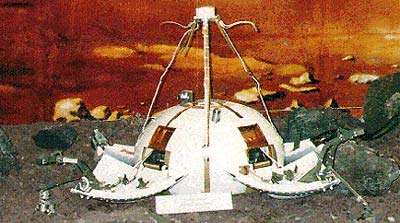
Cory: Especially if you've blown a tire on every trip you've taken before this. So after Roscosmos cuts the backup craft, the French decide that they've seen enough, and they pull their balloon project. With the French out, the Russians had to pivot once again. Instead of a balloon, Mars 94 would have two science stations in addition to the two surface penetrators.
And this setup is ultimately what Mars 96 launches with. However, given the state of the Russian economy, it becomes abundantly clear that 1994 is just not gonna happen.
So the mission was rescheduled for December, 1996, though the launch ultimately did happen in November.
Let's talk about what Mars 96 was designed to do and what kind of instruments were on board. Earlier , we built a case that the mission's big secret objective was to keep Roscosmos afloat through international funding.
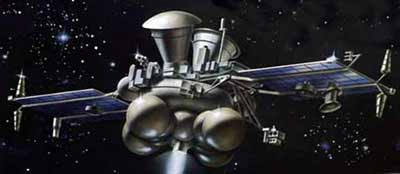
But the mission did have three overt scientific goals, all of which aimed to get the world as excited as possible about this mission. Those goals were: search for life and water, study the Martian climate, and identify resources that might help further human exploration. To do all that, the spacecraft had three components, which we've already named. The orbiter, two scientific stations, and two ground penetrators. Let's talk about the penetrators first. Imagine two 15 foot long golf tees that have a rocket strapped to the back that are designed to slam into the Martian surface at 220 miles per hour. Their job was to drill 20 feet below the surface and look for bacteria and water.
Cameron: NASA launched a similar mission in 1999 that was supposed to drill two feet. The Mars 96 penetrators, were supposed to go 10 times that.
Cory: We still haven't drilled much more than a few feet into the surface of Mars, so who knows what the heck's down there . In addition to the penetrators, the spacecraft also carried two science stations that measured things like weather and atmosphere and magnetic fields. Finally, there was the orbiter, which studied everything from gamma rays to dust storms. There were 12 instruments on board. Almost all of them international.
Cameron: And lest we forget, this was all Plan C, the trimmed down version of the original mission.
Cory: It is a very ambitious mission. It's a very high tech mission. And let's remember, Mars 96' s job was to secure funding from other countries, which it was very successful in doing. Over half the mission's funding came from the international community across 21 countries. But that mission funding was mostly to help Roscosmos with operational costs. It doesn't include the value of the instruments those countries put on board the spacecraft. France alone had $120 million in research equipment on board, which is what the Russians spent on the entire project.
Cameron: It's a testament to the mission that 21 countries were willing to roll the dice and overlook things like delays or no backup spacecraft. And I mean, why not? This is the first time humans are going to look for life on Mars. Who wouldn't wanna be involved with that?
Cory: Speaking of delays, the spacecraft took about seven years to build. All the while Roscosmos has to put up with things like hyperinflation, threats from parliament to pull the project, supply shortages.
Cameron: I know the thing that got you interested in this story in the first place was reading that the Russian engineers had to work on the craft by candlelight.
Cory: I learned that in a spy book where a character talks about Mars 96 in the context of explaining what Russia was like in the 1990s. I couldn't find any evidence that this actually happened, but the engineers did have a lot of blackouts while they were working on the craft. But worse than a blackout, during development many of the workers at Roscosmos weren't collecting a paycheck. The majority of this mission was foreign funded, but a lot of that was just payroll donations to keep the Russians working.
Cameron: Okay. So it's time to ask the obvious question. Is it unreasonable to attribute the mission's failure to the fact that this was all a pretty crappy environment to design and build an advanced spacecraft?
Cory: The mission's failure had nothing to do with the spacecraft. Now, there were a lot of failure points that it didn't get to encounter, so who knows if it was inherently flawed elsewhere, but at the point it did fail, it wasn't because of the spacecraft. It was the rocket that carried it into orbit.
We talked about how the sewage system backed up on the Mir space station.
Cameron: And they had to stir their poo with a stick.
Cory: They couldn't fix it for a long time because Russia didn't have enough money to build a rocket to resupply the station. And it was the same story with Mars 96. When it came time to prep for launch, there were no fresh rockets available. In what would be a very fateful decision, Roscosmos was forced to dip into the military stockpile. These launch vehicles were just repurposed missiles. The proton rocket they received had been sitting in storage for 10 years.
Cameron: It's like they custom built a sleek muscle car and then reached for some old grimy shed gas to fuel it up.
Cory: You know, I think at some point we've all been saved by shed gas. We'll get into more detail about what went wrong in the next section, but first, let's take a quick break. When we come back, we'll return to the day of the launch and the fallout pun definitely intended of this mission's failure.
Last we saw the Mars 96 spacecraft, it had successfully entered Earth orbit.
Cameron: Despite the dusty storage wars launch vehicle.
Cory: Yes. And actually, before we continue following the spacecraft, let's talk a little bit about the proton rocket it's riding on, because obviously it's important to the mission's failure. We talked about them earlier, but the proton was a series of Russian made rockets. They were probably the most successful workhorse rockets in history. Everyone, including the US, used them mostly to launch satellites into space.
Cameron: It's like what the Falcon 9 has been for the past decade or so.
Cory: Yeah. So, the proton rocket's job is to lift the spacecraft into orbit. It has four stages, which are essentially four independent rockets full of fuel stacked on top of each other. When the bottom most rocket runs out of fuel, it falls away into the atmosphere and then the next rocket starts firing.
It takes three stages to get into orbit, and then the final fourth stage, also called the upper stage, does what's called orbital insertion. And this is just where the rocket gets the spacecraft a little farther from Earth's gravity and then gives it a big push in the right direction towards Mars.
Cameron: Or where the planet will be in like 10 months.
Cory: That's true. And also kind of a wild way to think about it. After orbital insertion, the upper stage separates from the spacecraft and then falls back towards earth to burn up in the atmosphere.
Cameron: So at this point, there's no more proton rocket left. It's just the spacecraft heading towards Mars.
Cory: Correct. So that's how the proton works.
Let's go back to Mars 96.
Two and a half hours after launch, the spacecraft begins its second orbit around Earth. This is when that upper stage orbital insertion starts and that burn lasts for about nine minutes. As planned, the upper stage separates and falls back to Earth. The spacecraft is headed to Mars.
Let's imagine the scene. We're in, the mission control center, which was in Moscow actually. People are cheering and shaking hands. Maybe they're passing around a little celebratory vodka. Amid all this, a flight technician.
Cameron: Who I imagine is played by Clint Howard.
Cory: Exactly. Is tapping his computer monitor. There's something weird going on. From the information he's getting, the Mars 96 spacecraft is still way too close to earth. Nobody knows what's going on, but news spreads fast and the celebration becomes a panic.
Suddenly the mission is in emergency mode and there is no contingency for this.
Cameron: Yeah, they got rid of that contingency when they canceled the backup spacecraft.
Cory: Mission control has a quick huddle to talk options. Maybe somehow the spacecraft can still escape Earth's gravity. Or maybe they could bring the spacecraft down on the space shuttle and try the launch again. Or maybe worst case scenario, they just park it in orbit and do research on Earth. But to do any of those things, they need to immediately do another burn. Because right now the craft is scraping against the upper atmosphere and losing altitude by the second.
Cameron: I feel like at this point NASA would've just cut its losses and taken the hit. But I could see how desperate the Russians are and how much is riding on this when they're cooking up ideas like bringing it down strapped to the top of the space shuttle.
Cory: Now, the proton rocket is gone. If they're going to do the emergency burn, they have to use the spacecraft's own internal engine. But here's the thing, the Mars 96 propulsion system has, compared to a rocket, very little thrust and fuel, and it's just mostly used for minor course corrections.
It is not designed for a maneuver like this.
Cameron: That's definitely something that'd say in Star Trek.
Cory: It is. So despite this, they start the emergency burn, and for the next few minutes, everyone watches nervously as Mars 96 attempts to escape earth's gravity and push out into a wider orbit. But the result after the burn is actually worse than anyone expected. The spacecraft lost altitude again. Before this burn, Mars 96 had about 30 days in orbit. Now it had only a few hours.
Cameron: Okay, so how did Mars 96 have two burns and dropped altitude both times?
Cory: The spacecraft's engine wasn't designed to exit orbit. Also, there's pretty good evidence that the ship's autopilot took over on that burn and just blasted through all of its fuel in one go. But obviously it was the proton's upper stage that got the spacecraft in that mess in the first place.
The short answer is that for some reason the rocket was misaligned on its orbital insertion burn. That was programmed to last nine minutes. However, for whatever reason, it was traveling at about 1/200 of a degree in the wrong direction. That doesn't sound like much, but over nine minutes, that really adds up.
At the end of the burn, the spacecraft was something like six miles from where it was supposed to be.
Cameron: So nobody knows why that happened?
Cory: No. And I don't think anyone ever will. It could be a computer error, it could be something mechanical.
Cameron: Could be a nest of rats in the 10-year-old rocket.
Cory: The other theory I saw for the failure, which doesn't really make sense, but it's kind of interesting, is that the upper stage did have a successful burn, right? It got the spacecraft to where it needed to be, but the $200 part that disconnects it from the spacecraft failed. So as the upper stage fell back into the atmosphere, it towed Mars 96 with it.
Cameron: if that were true, I would've thought they'd fallen into the atmosphere together. But they were like a day apart, right?
Cory: Yes, but they didn't fall in the order you would think, which we'll get to. So after the emergency burn, Mars 96 is now orbiting at an incredibly low altitude. For perspective, most satellites sit at about 800 kilometers above sea level. Objects burn up in the atmosphere at around 75 kilometers. Mars 96 was at 86 kilometers.
Within hours, newspapers around the globe are headlining how the spacecraft that was supposed to find life on Mars is now burning up in Earth's atmosphere. Also, because the entire mission has been screwed up to this point. Nobody knows where the spacecraft or the upper stage are going to land.
Its location, speed, trajectory- these are all based on assumptions. The best guess from the USA is that it's going to hit Western Australia, which coincidentally is where parts of Skylab fell in 1979.
People were worried about where Skylab might fall because it was this huge structure. Mars 96 was much smaller, but everyone was freaking out because it was carrying a half pound of plutonium.
Cameron: Just to put this half pound into perspective, in 1997, people were protesting the NASA Saturn mission Cassini before its launch because it was carrying 71 pounds of plutonium.
Cory: A healthy golden retriever's weight in plutonium.
Cameron: It's still the most ever launched into space. NASA put the odds of a failed launch at one in 1300, which is about the same as five dice landing on the same number.
Cory: I've definitely done that in Farkle. So there's a radioactive spacecraft possibly hurtling towards Australia. US President William Jefferson Clinton makes an emergency call to Australian Prime Minister John Howard to warn him about the impact. The Australians scramble their civilian and military defense teams to Western Australia.
Cameron: You know, there was an old timer that was there when Skylab fell, who was like, my God, not again.
Cory: Roscosmos, along with the Russian ambassador to Australia, tried to calm everyone down. They insisted that if the spacecraft is going to crash land, the plutonium's casing was designed to survive way more of an impact than this.
But here's the thing, while all of this is going on, what the west doesn't know is that Russia has a pretty good idea where the spacecraft is going to land, and it's nowhere near Australia.
In fact, even as Clinton was telephoning, the Australian Prime Minister, Russia suspected that Mars 96 had already entered the atmosphere and crash landed. Initial thoughts were in the Pacific, near Easter Island, but it's more likely that it was on South America.
Cameron: why didn't they share that?
Cory: I don't know. It's Russia. My theory is that they were happy to have everyone distracted while they did their investigation. There's speculation that it fell somewhere near Chile or Bolivia, but who knows?
There's no evidence of any fallout. And in fact, there's no trace of the craft that's ever been found.
Cameron: What about that upper stage? We said earlier that they fell a day apart.
Cory: Yes, the spacecraft crashed a full day before the upper stage, which is weird because the upper stage is literally designed to beeline it back into the atmosphere. That just goes to show how bad the spacecraft's emergency burn was.
And that was the fate of Mars 96. Russia never sent a team to investigate potential crash sites because they couldn't afford a ship. Roscosmos investigated the failure and their findings are what presented here today. Russia' s future was dragged back to earth by an old Soviet missile. The experience was best summed up by the deputy head of Roscosmos. He said, it has come as a terrible blow for us all. We were pinning so many hopes on that unique mission.
Cameron: Describing the Mars 96 tragedy, one American paper wrote: "the probe that was intended to search for signs of life on the red planet instead sits under the deep blue."
The Russian headlines were a little more blunt: " we are the first to Easter Island."
The mission was, as you can imagine, a bitter tragedy. The gamble had failed.
Yuri Milov, the Deputy Director of Roscosmos, gave a sober view of the agency's ability going forward.
" We've decided to reconsider our whole program," he said. " We cannot do expensive projects, but maybe we can do some cheap ones. People can live calmly without knowing whether or not there is life on Mars."
After the loss of Mars 96, Russia severely limited its space program, and the world moved on. The Americans had 10 missions planned for the next decade, and that was just to Mars. Two weeks after the disaster, the Mars Pathfinder Mission launched for the Red Planet.
On November 8th, 2011, Russia launched its first interplanetary voyage in 15 years. They were going to return to but this time they were teamed up with a new ally, China, in what was to be that nation's first lander mission. After a successful launch, the craft arrived in earth orbit, but the Martian curse returned.
An electrical issue prevented the craft from firing thrusters. Like Mars 96, it degraded in orbit, but this time for 30 days. And like Mars 96, it landed somewhere near Chile.
To quote an article by the Planetary Society, " Cheap parts, design shortcomings, and lack of pre-flight testing ensured that the spacecraft would never fulfill its goals."
And that's the story of Russia's failure to reach and study Mars. The loss of Mars 96 ended the scientific rivalry between Russia and the US. Throughout the late 20th century, neither country was willing to let the other steal the headlines. If the US was going to keep sending astronauts to the moon, Russia was going to land probes on Venus. If Russia was going to build the first space station, the US was going to park an advanced telescope in orbit.
But after Mars 96, that was all over. By 1992, NASA had already entered its "faster, better, cheaper" stage. That meant smaller scientific probes and missions with a limited scope. And with Roscosmos all but gone, there was no real reason for NASA to stray from that conservative approach in the 21st century.
Cory: But beyond the loss of scientific collaboration, Mars 96 was also the story of a country and a space program that gave everything it had for one last attempt to prove itself. And the biggest loss here, I think, was for the Russian people. So at this point, Cameron, I would like the podium to entertain my own counterfactual alt history, Mars 96 Fanfic, to show a possible divergence in the timeline, had the mission succeeded.
Cameron: I'll allow it.
Cory: On November 9th, 1996, Mars 96 escaped earth's gravity and began its months long journey to the red planet. After the spacecraft successfully entered Martian orbit, festivals broke out in cities across Russia. A few days later, mission control prepares to send the ground penetrators to the surface. The nation is glued to their radios and television sets. Maybe for drama, one of the Penetrators crash lands on the planet, but then the backup successfully lands followed by both scientific stations. Two weeks later, America's Pathfinder arrives. There's polite clapping.
Meanwhile, the Russian penetrators carved 20 feet below the Martian sands freeing ice and rock samples that haven't seen sunlight for billions of years. Do they discover the answer to the question humanity has been searching for? Does it matter? The plucky Russians have proven they are capable and they've earned the trust of the international community.
Funds begin to pour in from across Europe and the US who readily admit that Roscosmos has far more of an appetite for these high risk, high reward showpiece missions. Within five years, the Russian Space Agency has doubled in size and dozens of missions are already on the drawing board. Engineers and scientists who fled during the troubled nineties return home. Not only that, brilliant minds from around the world, flock to Russia to work and study in the country's blossoming research, logistics, and engineering sectors. To compete, the US expands its own scientific institutions and announces wild interplanetary missions of its own. They plan to land a rover on Europa by 2010.
Russia says they'll be drilling there the following year. Space and science become a significant part of the Russian economy, and the sector is intimately tied to Western support. Russia needs the west and the west needs Russia. The nation's unpopular oligarchs struggle to contain a new generation of Russians excited about their future. In 2018, Russia elects its first truly democratic president. The world looks forward to a hopeful new century. One where the sky is never the limit.
Cameron: That's it for Mars 96.
Lost Threads is researched, written and produced by two humans: Cory Munson and myself, Cameron Ezell. To see some of the visual elements and sources from today's episode, go to lostthreads.org. And if you liked today's show and want to continue to support our work, please give us a follow on Spotify or wherever you listen to podcasts.