
Trans National
In 1952, Charlotte McLeod left her home in rural Tennessee to receive gender affirming surgery in Denmark. At the time, only one other American - a woman named Christine Jorgensen - had publicly undergone the procedure.
But while Christine's surgery had been simple and her homecoming celebrated by the public, Charlotte's experience was far more harrowing. From back-alley surgeons to ruthless media coverage, a lifetime of obstacles awaited the nation's second trans celebrity.
Listen today and hear how this pioneer of trans representation overcame it all to find the quiet family life she always wanted.
Sources:
- Le Maire, L. (1956). "Danish Experiences Regarding the Castration of Sexual Offenders." The Journal of Criminal Law, Criminology, and Police Science.
- Stryker, S. (2008). Transgender History. Seal Press.
- Denmark Won't Allow Sex Change Surgery. (1953, November 23). The Baytown Sun, Page 3.
- The Charlotte McLeod collection at the Digital Transgender Archive
- Jones, W. (1952, December 19). Christine Jokes Just Gag Them. Star Tribune, pp. 31.
- Audio interview of Charlotte McLeod by Susan Stryker
- Interview from Screaming Queens, dir. Susan Stryker
- Skidmore, E. (2011). "Constructing the "Good Transsexual": Christine Jorgensen, Whiteness, and Heteronormativity in the Mid-Twentieth-Century Press." Feminist Studies.
- McLeod, C. (1956). I Changed My Sex. Mr. Magazine.
- Song: Masculine Women, Feminine Men by Merritt Brunies Friars Inn Orchestra, 1926.
Episode Transcript
Cameron: In 1952, Christine Jorgensen became an overnight sensation after returning to the United States from a life-changing trip to Denmark. While Christine Jorgensen was not the first person to receive gender-affirming surgery, she was certainly America's first trans celebrity.
From the moment she stepped off the plane and landed in the United States, the news was obsessed with Christine and wrote about her every move. Meanwhile, in Dyersburg, Tennessee, another former GI would pick up a paper to see the news about Christine Jorgensen and immediately set sail for Denmark
Cory: Today on Lost Threads, we're discussing Charlotte McCleod, who followed in the footsteps of Christine Jorgensen to find gender-affirming care abroad. but whIle the former's path led to stardom and public adoration, Charlotte's journey would prove to be far more difficult.
I'm Cory Munson.
Cameron: And I'm Cameron Ezell. We'll be right back.
Although many parts of her story are eerily similar to the challenges and barriers the transgender community face today, Charlotte McLeod grew up in a very different society. So before we dive into her story, let's lay the groundwork for how people in the mid-20th century conceptualized things like gender fluidity or transgenderism, which was actually not nearly as conservative as you'd think.
Cory: And the best person to illustrate that is the lady we mentioned in the intro, Christine Jorgensen, who was one of the first transgender people to attract public attention nationwide. She may not be a household name today, but it's hard to overstate just how huge of a celebrity she was.
In her book, Transgender History, Susan Stryker writes
" in a year when hydrogen bombs were being tested in the Pacific, war was raging in Korea, England had crowned a new queen, and Jonas Salk was working on the polio vaccine, Christine Jorgensen was the most written about topic in the media in 1953."
Cameron: Before we started researching this, I was only somewhat familiar with Christine Jorgensen since she was talked about in the Tim Burton movie about the director Ed Wood. His movie Glen or Glenda was actually loosely based on her story. But like you said, she was a major celebrity and was on TV, talk shows, radio, movies.
And this was one of the first times that the average American started hearing about the concept of sex change operations. I should note that's a dated term and we call it gender affirming surgery today. But this is the term that people were hearing about in the papers at the time.
Cory: Yeah, and we should also add that just because people in 1952 were hearing about this for the first time, It doesn't mean Christine Jorgensen was the very first person to have this surgery. In fact, the type of procedure Christine underwent was already a generation old and had been happening in Europe since at least 1922.
Cameron: Yeah, the US was pretty slow to catch on to the practice, both culturally and scientifically. John Hopkins didn't conduct the first legitimate hospital-sponsored gender-affirming surgery until 1966. Before then, it's not like there was a specific law on the books that said you can't perform gender-affirming surgeries, ' cause it was a new technology, right?
But there were laws against cross-dressing and homosexuality or whatever else that punished people for not conforming to traditional gender roles.
Cory: But more than any legal constraint, what really prevented these surgeries is that they didn't even occur to most doctors as a viable form of treatment. In the early 1950s, when a lot of today's episode takes place, you could literally count the number of US medical professionals researching or practicing gender-affirming care on one hand.
One was a German-American endocrinologist named Harry Benjamin, who was not only Christine Jorgensen's doctor, but at the time was one of the only doctors in the US who prescribed or referred patients for gender-affirming care. And honestly, it's a shame that he's not more widely known today
Cameron: The interesting thing about him is that he never set out to become one of the most important advocates for the transgender community. He was actually more involved in hormone therapy like estrogen and testosterone because he wanted to use them to prevent aging. Later in his career, he started using those therapies instead for his transgender patients.
The first time he came across somebody who kind of fit this bill was in the late 1940s when he met a patient born with male sex organs but had been raised as a girl. They initially came to Benjamin because, as you can imagine during this time, they never had any treatment before, and they had anxiety and depression.
So he went back to his previous research on estrogen and used that, which was ultimately an effective form of treatment.
Cory: The reason that Benjamin was so effective and groundbreaking is because he arrived at his transgender patients as a biologist rather than a psychoanalyst. People under the Freud school of thought who said that this was something that needed to be talked through and resolved cognitively. But for Benjamin, there was just something wrong with their biology that needed to be addressed. His patients weren't anxious and depressed because they had a disorder that needed to be corrected.
Clearly, something like estrogen therapy was effective and fulfilled a basic need that they weren't getting, so why would he have an issue prescribing it?
Cameron: Yeah, absolutely. He saw his job as a way to provide case-by-case treatment to improve the patients' lives, and that could include encouraging them to wear clothes that they were more comfortable in or prescribing hormone therapy.
Cory: And as a final aside on Dr. Benjamin, he was born and raised in Germany, and it's no coincidence that he had a pretty different perspective on the transgender communities than a lot of his American colleagues. Germany is where modern research for queer and transgender lifestyles basically started. You might have heard of gay Berlin of the 1920s, That was a period when LGBTQ communities were accepted by the general population
Cameron: And a lot of that gay Berlin acceptance was thanks to Dr. Magnus Hirschfeld, who was a friend of Dr. Benjamin. Hirschfeld founded the Institute for Sexual Science, which did a lot of that early research you mentioned. But unfortunately, that era ended when the Nazis came to power, and the institute was destroyed by protesters in 1933
Cory: Not the last time Nazis will appear in this story.
Cameron: So going back to the US, Dr. Benjamin spent his career pioneering treatment for his transgender patients. But if his interventions weren't enough, he was one of the only doctors in the US who could recommend and provide contacts for surgery in Europe, which is ultimately what he did for Christine Jorgensen
Cory: And it's worth mentioning that there's no way of knowing if Christine Jorgensen was even the first American to undergo a gender-affirming surgery. she Was just the first person to have gone public about it.
It's not like doctors would have announced this type of treatment back then.
And Christine made herself public because she was a media darling and absolutely loved the spotlight. And it's a lucky thing for many trans people around the US that she put herself out there because our subject today, Charlotte MacLeod, would have never known that this was even an option until that one fateful day when she picked up a paper and read about a treatment that would literally save her life
Charlotte McLeod was born in 1925 in Dyersburg, Tennessee. She was assigned male at birth, but never built out a masculine physique and was often mistaken as a girl in boy's clothing. Here's a clip from an interview a 77-year-old Charlotte had with Susan Stryker, the gender and sexuality researcher we mentioned earlier.
Cameron: From that interview, Charlotte talks about putting on a skirt and going out to dance with soldiers in her community. She was a lot taller than the other girls around her, so she was drawn to some of the taller soldier men It surprised me that even though it's the late 1930s or early '40s in rural Tennessee, the community, her family, her friends were all pretty accepting of who she was.
I found this from the Star Tribune in Minneapolis in 1952. One of their humor columnists, Henny Youngman, had made a joke in the newspaper about Christine Jorgensen. The paper got a flood of complaints from readers. A local reader, Catherine Murray, said, "I think a person who has the courage to transfer himself such as she has a perfect right to be treated as a woman, the same as any other."
Henny Youngman was pretty unapologetic about his joke, but the newspaper editor made the statement, "In cities all over the country, there are others who would do the same as Christine if they had the opportunity and the money and thought the same as she did
Cory: That said, let's be careful not to paint this era as some kind of utopia. Charlotte was still a trans woman in rural Tennessee, and her experience would have been incredibly confusing and isolating.
Cameron: When Charlotte was a teenager, her grandmother encouraged her to seek out specialists who might know something about her condition. But as we've established earlier, this was the late 1940s, and doctors just couldn't help her or even understand the problem. In fact, most doctors recommended she take hormones that would make her more masculine.
So let's fast-forward a few years to when Charlotte was around 25 years old. The Korean War had just begun, and she attempted to join the cause and enlist. Although she successfully managed to bribe her way through the admission process, Charlotte was soon declared unfit for service and discharged because she lacked the strength to handle a rifle.
Here's Charlotte again
After leaving the military, Charlotte's friends recommended she move to a gay community in cities like San Francisco or New Orleans. She gave New Orleans a shot, but it really wasn't a good fit
Cory: And it's not hard to see why. Charlotte saw herself as a straight woman. She didn't identify with gay culture at all. There was this interview where she said she found it all way overly promiscuous.
Based on what I've read, she kinda just comes across as your typical prudish housewife from the era. All she wanted was to settle down with a husband and have a family.
Cameron: So ultimately, Charlotte had hit a dead end. Doctors couldn't help her. She didn't belong in the military, New Orleans, or even back home in rural Tennessee. She began to believe that she'd never have the life she wanted. But then in December 1952, everything changed. Christine Jorgensen was front-page news across the world. All her problems were solved by a simple visit to a Danish hospital. Now, for the first time in her life, Charlotte knew what she had to do
Cameron: Once news broke about Christine Jorgensen, Charlotte MacLeod wasted no time
Charlotte was ready to leave for Denmark. But first she made a quick stop in her hometown of Dyersburg. There she met with her father to discuss her decision. At the time, he seemed to accept her choice to travel abroad for the surgery. Next, Charlotte traveled to New York and booked a ticket on a Dutch passenger liner, the MS Maasdam. Most of her fellow passengers were on their way to England for Queen Elizabeth II's coronation.
After two weeks at sea, she had arrived But unfortunately, upon arrival, she received two devastating pieces of news . The first was from her family. They said that after talking it over, they couldn't support the surgery anymore. To them, it sounded way too risky.
I mean, you have to consider this was a brand-new procedure, and I can kind of see it from their perspective. However, the other news was a bigger problem. Denmark had passed a law during Charlotte's voyage across the Atlantic. Based on the publicity received by Christine Jorgensen, gender-affirming surgeries were now illegal to non-citizens over the age of 26. Charlotte was 27.
Cory: And it's here I think we should talk a little bit about why Denmark even offered this procedure in the first place. We're pretty familiar with Europe being progressive with sexuality, but the original law that made this surgery legal had nothing to do with gender-affirming care. In fact, the surgery Christine Jorgensen received was an unintended consequence of an earlier law passed in the 1930s that allowed people who were in prison to voluntarily undergo castration. The idea was that this would eliminate their desire to commit specifically sex crimes, and in exchange, the convicted would usually be granted some kind of parole or early release
Cameron: And I'd like to note that, quote, "voluntary castration laws" are a bit of a horrifying topic that other countries like Nazi Germany passed for overt eugenic programs, which is, again, not the last time we'll talk about Nazis in this episode.
Cory: But yeah, this law created a legal loophole for gender-affirming surgeries. Any adult could walk into a hospital and request a medical castration. And like we were talking about earlier, it was quietly going on in the background until Christine told the whole world that you could just go to Denmark and do this.
And in response, the Danish government said that they would reduce access to the surgery to people over twenty-six .
We found one paper where A Danish government official said, quote, " Denmark does not want to become a service station for sex change surgery Ultimately, it sounds like they didn't wanna flood Danish hospitals with medical tourists.
Cameron: So Charlotte's lost the support of her family, and now the surgery she's come to Europe for is no longer available. Not sure how she's going to proceed, she checked into a hotel in Copenhagen to think about her next steps. For Charlotte, going home wasn't an option. In a magazine article written by Charlotte published in 1956, she wrote, "I risked all on the dangerous gamble of surgery. I did so because I found life so unbearable that I truthfully would have preferred to have it end than to continue as a living lie, a man who wasn't really a man at all."
Desperate, she began to look for an alternative solution.
Cory: A few days later, Charlotte was sitting on a park bench in Copenhagen. Deep in thought, she almost didn't notice the young couple who had joined her. The three struck up a conversation, and before long, Charlotte confided in them about her current predicament. Sympathetic to her story, the couple referred her to a man they knew who might be able to help. His name was Dr. Emil Peterson now, residents in that neighborhood were pretty familiar with Dr. Peterson. Even if they didn't know exactly who he was, the guy was hard to miss
Cameron: He really fit the bill of a spooky doctor. He had a hunchback and a deformed skull, which was a result of an old gunshot wound. He was also addicted to narcotics, which made him involuntarily flap his arms all the time
Cory: But what really made him the perfect caricature of a villain was how he would spend the late hours of the evening strolling through the streets of Copenhagen with his giant Great Dane
Cameron: Well, he also used to work for the Nazis
Cory: Um, I'm not sure if he was a Nazi, but he was definitely a collaborator as a medical professional during the war
Cameron: Charlotte said that his apartment was full of really expensive art, and she thought he was probably dealing stolen Nazi artifacts out of his house
Cory: There were obviously a lot of red flags, including the fact that Charlotte wasn't sure that he'd ever done a surgery like this before. But despite all of this, Dr. Peterson was the only viable option she had for this operation, so she asked the couple to arrange a meeting.
On the day of the surgery, Charlotte arrived at the doctor's small apartment, but there was already a problem. Dr. Peterson would need to wait until he was sober enough to perform the operation, but he also needed to be somewhat high to avoid the symptoms of withdrawal.
He said that if he took a large enough dose of narcotics at 7:00 PM, he should be alert and sound of mind by around midnight So Charlotte waited in the living room with the doctor's wife and son, very aware of how bad the situation was. At the very least, she felt that she could trust the doctor's family to take care of her if something went horribly wrong. And so all evening she sat in the living room watching as a stream of customers dropped by to purchase illicit drugs. When it was finally time to begin, Dr. Peterson told Charlotte to lie down on his kitchen table. This is where he would perform the surgery. He administered anesthesia and Charlotte drifted into unconsciousness.
When Charlotte opened her eyes, she was in incredible pain. Dr. Peterson told her that the surgery had not gone well. At one point, she had stopped breathing and was only brought back to life with artificial respiration. She had also hemorrhaged a lot of blood. And while Dr. Peterson had successfully removed the male sex organs, he'd begun to experience withdrawal near the end of the surgery and did a horrible job stitching her up So Charlotte spent the next few days in the house trying to recover, but her condition only got worse and worse. And during this time, Dr. Peterson never checked in on her. Only his wife and son dropped in. One night, Charlotte heard a crash outside her room. Dr. Peterson had overdosed and fallen down. She got out of bed to help him, but tore her stitching in the process, which led to an infection. In critical condition, Charlotte escaped the small apartment and collapsed in front of the nearest hospital. When staff saw the state she was in, they were appalled. And despite the law, they stepped in to save her life. She would now have to go through a second operation to correct the doctor's mistakes
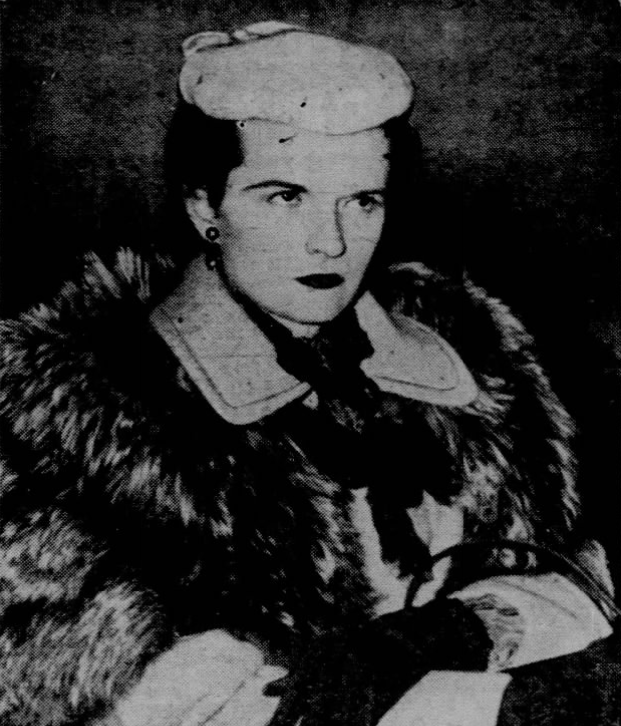
Following her second surgery, Charlotte remained in the hospital to recover for an entire year. But finally, in February 1954, she returned to the US triumphant. She had survived the back alley operation, and for the first time in her life, she felt comfortable in her own body. But unfortunately for Charlotte, her journey to enjoy a normal life was far from over. Like Christine Jorgensen, she would soon be front page news. But unlike Christine, Charlotte was not looking to embrace the limelight. And because of that, she was about to get a very rude homecoming.
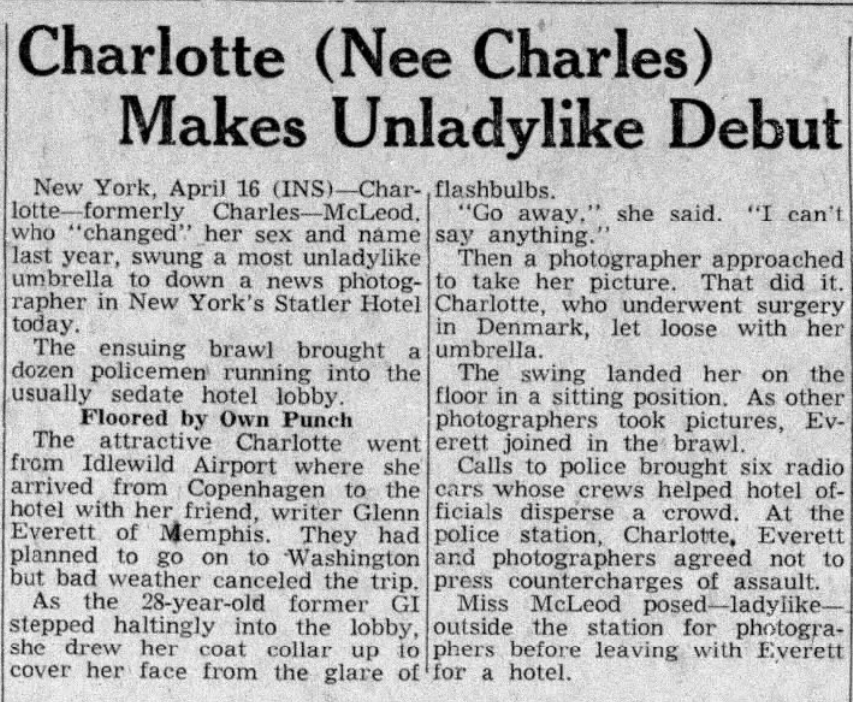
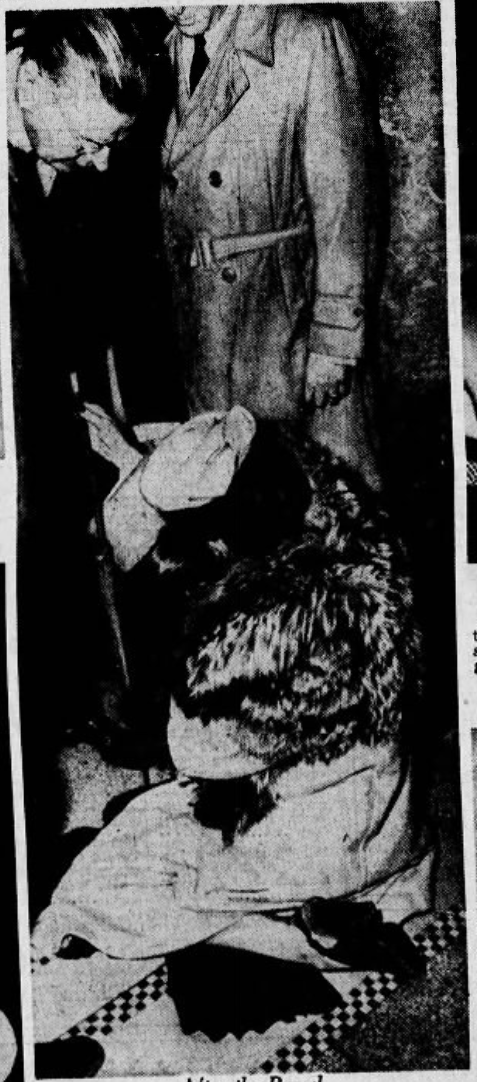
Cameron: Walking with her umbrella as a cane and wearing a hooded cape, Charlotte stepped off the plane to a flood of reporters. Why would they be here? As she waded through the crowd, she covered her face. Suddenly, one of the photographers rushed forward and ripped the fabric away. Charlotte hit him with her umbrella, and someone knocked her to the ground.
The rest of the crowd began snapping photos as she lay on the tarmac. That was the image most newspapers used to introduce Charlotte McLeod to the American public.
Cory: The photo of Charlotte on the tarmac really feels like one of those images that would be in every US history book in perhaps a brighter future where they talked about those things in school.
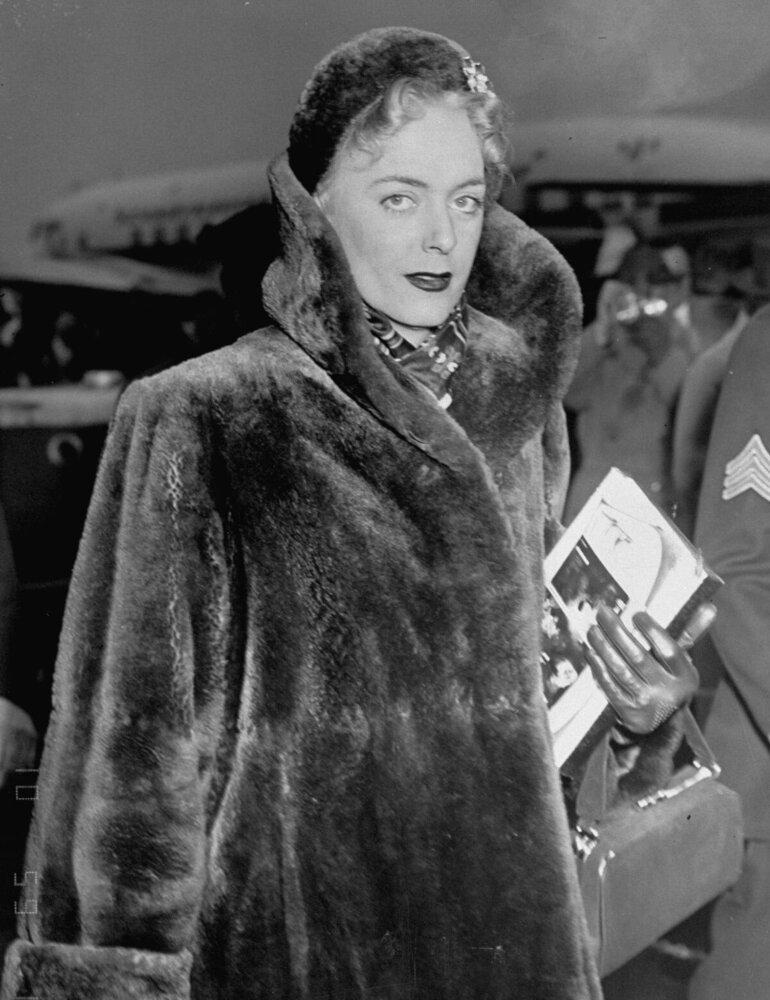
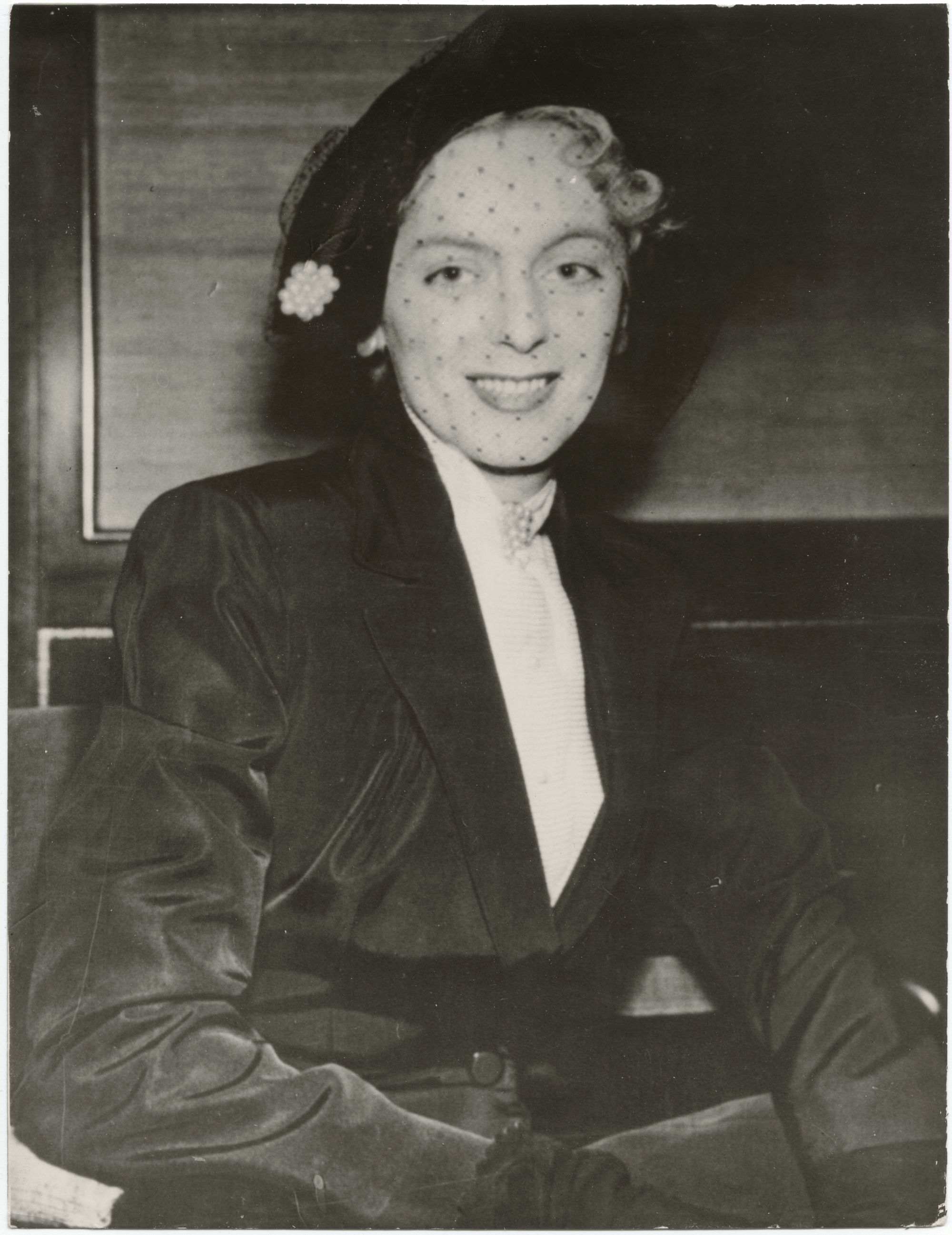
Cameron: Yeah, It really has This sort of quality that evokes a lot of the civil rights imagery we're used to seeing back in the 1950s and '60s. So I'm gonna put it on our website next to a photo of Christine Jorgensen's first photo back in the US. It's night and day by the way, that question of what were those reporters doing there, Charlotte later claimed that Christine Jorgensen, of all people, had leaked the news of her surgery in Homecoming.
Cory: Why would she do that?
Cameron: Well, there's no way to know if it's true. That's just what Charlotte said in the Susan Striker interview
But to answer your question, maybe Christine was excited to have someone like her in the limelight and wanted to give her the red carpet treatment.
Who knows really?
Cory: but you're right,
their public reveals couldn't have been more different. Christine Jorgensen steps off the plane and she's suddenly a movie star. We didn't mention this, but after Charlotte was knocked down to the ground, she was arrested for assault,
Cameron: Yeah, for assaulting the journalist
Cory: And so she leaves the airport in a police cruiser, bleeding and bruised from being knocked down. Is it because extroverts rule the world? I think that might be a small part of it, right? Christine was this singer and a dancer and an entertainer, and she's very charming. You can find tons of clips of her performing and speaking
Cameron: I mean, you're not far off. Charlotte was a very private person. She wasn't looking for any attention. The media came for another show like Christine Jorgensen, and Charlotte didn't give it to them, and it made her an outcast.
Cory: So do you think if the media hadn't been tipped off, Charlotte would've gone on to live this totally normal life under the radar?
Cameron: I mean, I think so. Like we said earlier, these two ladies are just the first surgeries we know about. It's totally possible that all these Americans had come over from Europe over the past decade and just lived a quiet life.
Charlotte mentioned in her interview with Susan Stryker that the people involved in Denmark went to great lengths to keep these things quiet, and that's why they put in the new law after Christine's story got out
After her public reveal, Charlotte returned to the South to reunite with her friends and family and start her life anew.
Back in Tennessee, she was accepted with open arms by her community. " I fit right in where I left off," she said. "It's wonderful to be back home. Friends don't feel any different towards me now than before. They've accepted the many changes."
Her dad told the papers, "I was happy to see her. I hope this change will be better. I hope she'll be happy."
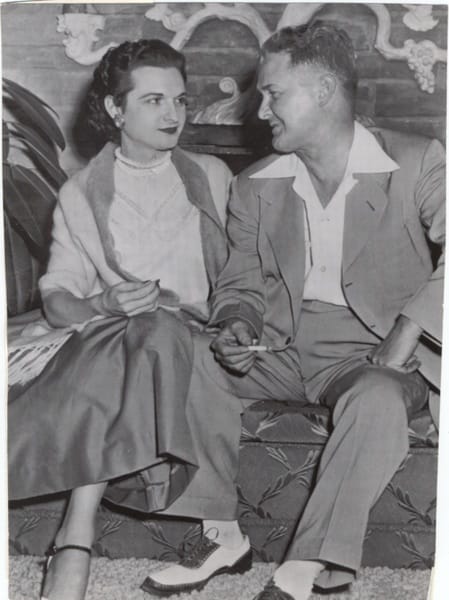
Cory: There's actually a photo of her with her dad after returning home and they're, like, sitting on the couch together, and I really like it. You can tell her dad loves her a lot
Cameron: but Charlotte couldn't stay in Dyersburg forever. There was a whole world out there to explore. So like many people in their late 20s, she moved from place to place trying out different communities and careers.
So over the next few years, Charlotte worked a number of jobs ranging from a beauty salon in New York to a receptionist to a hat check girl at nightclubs in New Orleans. She got a lot of offers from nightclubs.
She had been working as a bookkeeper before her transition, and afterwards, all of the job offers coming in were to work at strip clubs or nightclubs doing, like, a burlesque routine, or maybe it was just doing a comedy act or something on stage because she was seen as an oddity, and she wasn't being given any real opportunities.
But it wasn't just Charlotte. This was a larger problem that affected many queer people during this time They were given only certain jobs. And a lot of times that resulted in people, being forced to act as sex workers essentially Here's an audio clip from an interview featured in the Susan Stryker documentary, Screaming Queens. It gives some context around what job opportunities looked like for many trans women around the middle of the twentieth century
Going back to Charlotte, she's in her late 20s She's searching for opportunities. She's trying to find her way in the world. But everywhere Charlotte went, the media followed her, and for years the papers went out of their way to other her and report on anything remotely interesting Humiliations and setbacks, though, were particularly newsworthy. After losing her housing from a Baptist church lodge, a church spokesperson told a reporter, " We have done what we could for Charlotte and will continue to do our Christian duty toward a person in distress, but we just cannot take this.
We have therefore told Charlotte that we thought it would be wisest if she found another place to stay."
Cory: We offer Christian charity, but I mean, she's really a little too much. Meanwhile, Christine's line dancing in Hollywood films. It's like we said, if you're going to be outside the norm, you better be entertaining and charming
Cameron: Yeah. An article by Emily Skidmore published in Feminist Studies made this exact point. It says, quote, " One of the most significant distinctions between the ways in which Jorgensen's and McLeod's stories were told in the mainstream press was that Jorgensen's story was most often articulated through her own voice or within interviews of her parents.
McLeod's story was rarely articulated in her own voice, and newspaper editors virtually always had the last word
Cory: You can do interviews, refine your brand, and be a star, or you can hide and you'll be a tabloid figure.
Cameron: But yeah, they reported on everything she did. This one is from the San Francisco Examiner. It wrote, " Charlotte doesn't look forward to nightclub work, but thinks it necessary to pay bills. She said she is looking forward to married life and a home of her own."
Cory: That's not even interesting gossip
Cameron: I know. And like she said, her dream was to raise a family and enjoy a quiet life. And papers or no, she was going to do her best to achieve that. In the late 1950s, Charlotte moved to Miami where few knew or suspected anything about her past. In 1959, she married a man named Ralph Hydel. Unfortunately, the Miami Herald had caught wind of the wedding and published an article outing her. and Charlotte became front page news all over again. Now everyone knew I found it funny that the reverend who performed the ceremony was quoted as saying, " I wonder what the deacons will say."
Cory: That is a panicked man who knows 1950s America is never going to let him perform another marriage. But seriously, talking about which job she's taking is one thing. Destroying the happiest day of her life is just tragic
Cameron: Charlotte's first marriage didn't last long. It didn't really have anything to do with the media attention, and, you know, I can't imagine her surgery was news to her husband. Basically, he wanted to go back to New York. She wanted to go to California. Sounds like normal relationship stuff kind of broke things up
Cameron: So after the divorce, she moved to Laguna Beach to be closer to friends, and that's when things began to turn around for Charlotte McLeod
In California, she met a man who had recently become a widower with two kids, ages 11 and 12. Although this marriage would end in divorce after seven years, Charlotte became a mother to those children, and they called her Mom. And her stepdaughter would eventually have two children of her own who would grow up calling Charlotte Grandma. By the time she moved to California, the media attention began to drop off. We don't know much about Charlotte's later years, which is exactly how she wanted it. She finally found a quiet life surrounded by family and loved ones. Charlotte McLeod passed away in 2007 at the age of 82
Cory: Um, Cameron, we actually do know some details about her life in California
Cameron: Oh yeah, that she witnessed the Manson murders. Yeah, I, I didn't know how to fit that into the script
Cory: It's a wild story from the Stryker interview. Charlotte says, "After I married, I was at a friend's house at one of the canyons. In the other canyon across the way, you could see the people. You couldn't hear anything, but you could see the people on the deck. We were out there the night that horrid Manson massacre took place. I don't remember the date, but I remember the horrible things that happened
Cameron: Yeah, like I said, it definitely didn't fit in our story
But before we close out, there is something we wanted to talk about. We don't usually editorialize our shows too much and, you know, we just like to let the history speak for itself. Charlotte McCleod was able to make this change because she saw representation of herself through Christine Jorgensen. But we have to mention that it's really interesting that not only is the story of Charlotte McLeod, or for that matter Christine Jorgensen, not really well known, in many places in the US, these stories are actively erased. Schools, museums, libraries, all of them are targeted and forced to remove any mentions of LGBTQ history. There are thousands of stories like the one you heard today that are illegal to teach in parts of the country. We're only too happy to share this forbidden knowledge, and we hope you seek more out .
If you want to learn more about trans history specifically, I highly recommend checking out the Digital Transgender Archive, which was an important part of the research for this episode. Lost Threads is hosted and independently produced by two humans, Cory Munson and myself, Cameron Ezell if you enjoyed hearing about Charlotte McCleod today and want to see some visual components from this episode along with our sources, you can visit our website, lostthreads.org Please remember to subscribe on Spotify or wherever you get your podcasts so you can stay updated on our releases.